Why Feeding Bans Don't Work
Read more about why feeding bans don't work to eliminate stray and feral cats
Why provide shelter for neighborhood cats?
Read our Outdoor Shelter and Feeding Station Idea Sheet
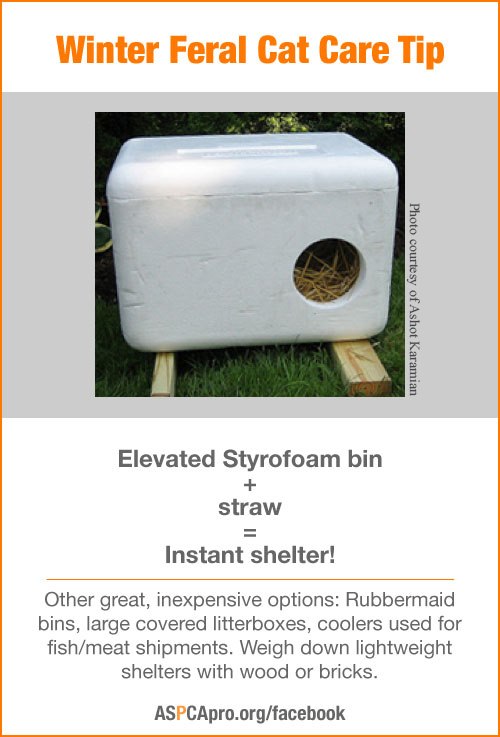 In cold weather, shelter is actually more important for stray & feral cats
than food. Even though feral cats build thicker coats for Winter, they can quickly
succumb to hypothermia, particularly in rain & snow when their fur gets
wet and doesn't insulate as well.
In cold weather, shelter is actually more important for stray & feral cats
than food. Even though feral cats build thicker coats for Winter, they can quickly
succumb to hypothermia, particularly in rain & snow when their fur gets
wet and doesn't insulate as well.
In emergency situations in Winter, if you do not have quick access to a shelter.....a
strong cardboard box or container preferably weather proofed with plastic,
trash can turned on its side, large plastic tub turned upside down with a door
added etc, can provide a temporary solution until a more permanent shelter can
be obtained. It's more important to do something to protect the cats from
the cold and elements than to wait for "the right" shelter. Unless
you operate a managed colony, don't underestimate the number of cats in your
area...you may only see one or two, but there are probably more. Try to provide
more shelter space than you imagine needing.
Bedding, location, and other considerations
Thick straw bedding allows the
cats to "nest" and curl up into heat-conserving positions with the
bedding providing a wind-break and insulator. In some cases, tacking strips
of cloth over the shelter openings can provide additional protection from drafts,
but may require additional "training" to get the cats to enter the
shelter. In very harsh conditions, caretakers may wish to provide weatherproof
dog-house heating pads. These are constructed of sealed, heavy plastic with
damage-resistant cords. Only use these if you can safely run power to the unit
using a Ground Fault Circuit Interrupter (GFCI). The GFCI will disconnect the
power in the event of a short circuit or damage to the cord. When plugging a
heater cord into an extension cord, make sure the connection does not lay on
the ground where it might be prone to water. Special waterproof extension cords
are available at hardware stores.
 Locating the shelter is also an important topic. IndyFeral recommends using
neutral and earth tones to blend with the environment. We recommend
that shelters be located away from areas of vehicle & foot traffic. Locating
it in a wooded area, or in the margin of a wooded area is ideal, as this provides
cover from the elements and makes the shelter less obvious. In more developed
areas, locate the shelter behind buildings or someplace where it will not be
disturbed. Cats will shun shelter if they are disturbed there regularly. Orient
the shelter to block the entrances from receiving direct wind and rain/snow.
In central Indiana, the prevailing winds are usually from the south to the west.
It may also be helpful to place sturdy building materials adjacent to the entrance
to provide additional wind protection -- about 12" from the entrance would
be fine. Make sure that if you place anything over or around the shelter that
it is anchored firmly and will not blow or fall over in front of the entrance. Locating the shelter is also an important topic. IndyFeral recommends using
neutral and earth tones to blend with the environment. We recommend
that shelters be located away from areas of vehicle & foot traffic. Locating
it in a wooded area, or in the margin of a wooded area is ideal, as this provides
cover from the elements and makes the shelter less obvious. In more developed
areas, locate the shelter behind buildings or someplace where it will not be
disturbed. Cats will shun shelter if they are disturbed there regularly. Orient
the shelter to block the entrances from receiving direct wind and rain/snow.
In central Indiana, the prevailing winds are usually from the south to the west.
It may also be helpful to place sturdy building materials adjacent to the entrance
to provide additional wind protection -- about 12" from the entrance would
be fine. Make sure that if you place anything over or around the shelter that
it is anchored firmly and will not blow or fall over in front of the entrance.
Ideally, we suggest that stray & feral cats have access to heated shelter
with clean dry bedding. Recognizing that it may be difficult, if not impossible
to provide this, IndyFeral has compiled a list of resources for buying or making shelters for cats.
Outside Shelter Resources
Are you looking for the shelters IndyFeral used to sell? FeralVilla is now producing and selling them.
These outdoor shelters are constructed from durable, weather-resistant,
all-wood construction. They are insulated with a non-toxic, foil-faced insulation that reflects their body heat. The bottom parts are made from rot & insect resistant
wood and may rest directly on the soil. The roof comes off for easy cleaning.
That cleaning would consist of removing old bedding material or other debris
and putting in fresh bedding.
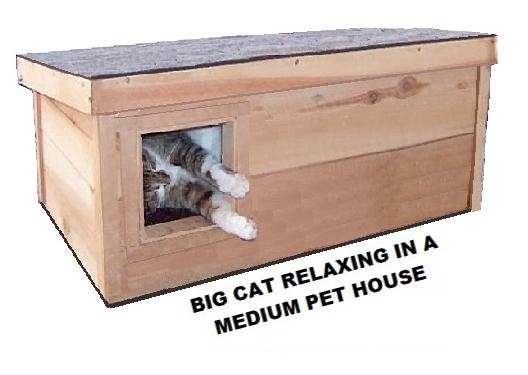 Warm durable all cedar outdoor cat houses for ferals, strays, and
house cats from The Ark Workshop. Warm durable all cedar outdoor cat houses for ferals, strays, and
house cats from The Ark Workshop.
The Ark Workshop offers a variety of outdoor shelters and feeding stations for reasonable prices.
Electric heating pad and heated water bowls: Make sure they are rated for outdoor use
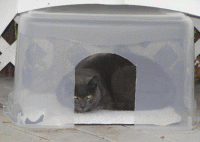 If you have an outlet handy, you can safely provide some extra warmth for the cats with an outdoor rated electric heating pad and keep their water from freezing by using an electric heated water bowl. These products can be found in many pet supply stores or online through Amazon or other online retailers:
Non-Electric Heating
If you don’t have access to an electrical outlet for the cats consider a "SnuggleSafe" thermal disc. It is a plastic disc with a special thermal compound inside that stays warm for hours when heated in a microwave for 5-7 minutes. Wrapped in a cloth the cats can’t open, the disk is a great way to provide warmth. They are also often available at pet supply stores or through Amazon:
Simple Feeding Station Ideas
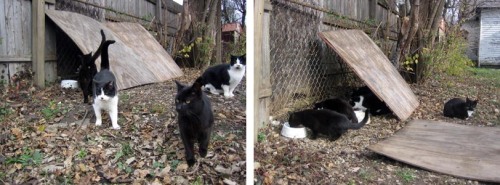
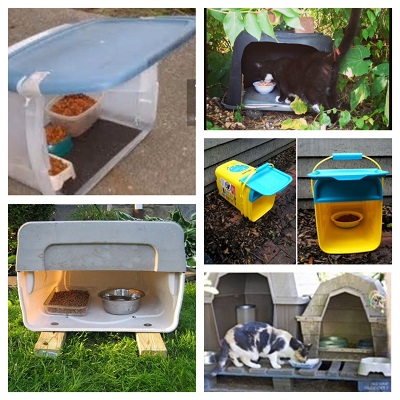
A piece of plywood leaning against a wall can provide a sheltered area for feeding cats. It is cheap, easy, inconspicuous, and can be moved or taken down when not needed.
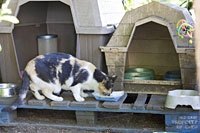
LEFT: An unused igloo-style or other plastic doghouse can make a good feeding station for cats. If you do not have one, they can often be found at garage sales for much less than the price of buying new.
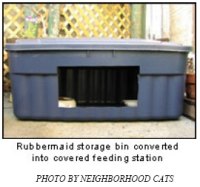
RIGHT: A large plastic tote can be converted into a feeding station easily by cutting a large opening in the side. The food can be tucked around towards either end, keeping it well sheltered and allowing multiple cats to feed at the same time.
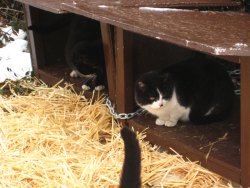
LEFT: A simple wooden feeding station can be built by anyone with basic wood-working skills. This example, built by Habitat for Dogmanity through the "Habitat for Catmanity" program, is open on one side, has an overhanging slanted roof to draw rain away from the opening, is deep enough to hold cats and food dishes, and is slightly raised off the ground.
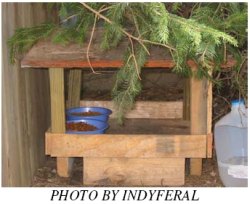
RIGHT: Another wooden feeding station design, this example is open on all sides, which offers less protection from the elements but allows more cats to feed at one time.
BELOW: More ideas for simple, quick feeding stations.
Other types of shelters and feeding stations you can build or buy
Indianapolis Area Pet Food Pantry Resources
 Indianapolis Pet Food Pantry, 456 Holmes Ave, Indpls. IN 46222. The pantry is open for dog/ cat owners and colony caretakers every 1st and 3rd Saturday of the month from Noon-4:00 pm. Animals must be spayed or neutered. Operated by FIDO, www.fidoindy.org, call 221-1314. Indianapolis Pet Food Pantry, 456 Holmes Ave, Indpls. IN 46222. The pantry is open for dog/ cat owners and colony caretakers every 1st and 3rd Saturday of the month from Noon-4:00 pm. Animals must be spayed or neutered. Operated by FIDO, www.fidoindy.org, call 221-1314.
|